

The UK Driving Test
The Driving Instructors at Bay School of Motoring will always be on hand if you need any information or help in arranging your examinations.
Below you will find details of common questions asked about the Driving Test. Click the links below to be taken to UK Government website to see the latest information provided by the Driver & Vehicle Standards Agency
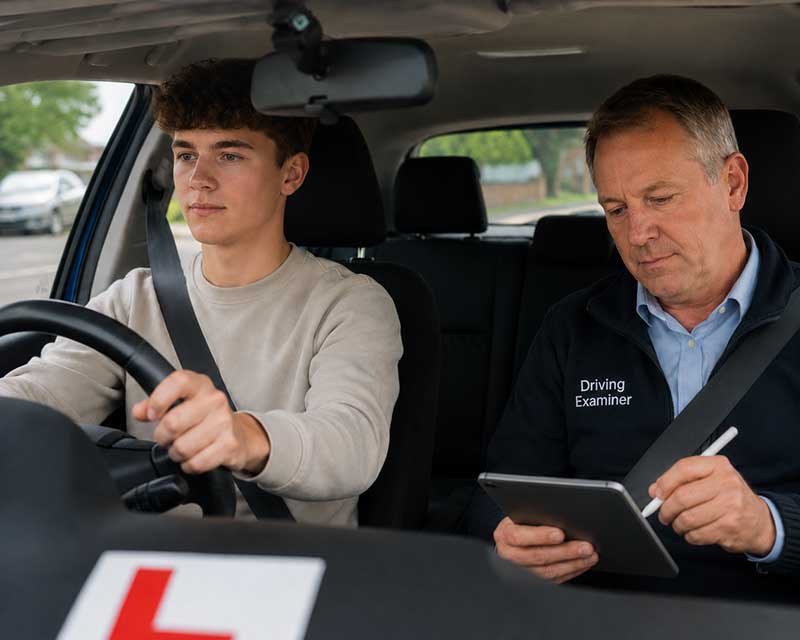
Frequently Asked Questions About the UK Driving Test
(The information below is taken from DVSA website 30 July 2026 - please check the Driver & Vehicle Standards Agency for the latest information)
How long is the UK practical driving test?
The practical driving test lasts around 40 minutes. If you're taking an extended test following a driving disqualification, it lasts around 70 minutes.
What do I need to bring to my driving test?
You should bring:
- Your provisional driving licence.
- Your theory test pass (if requested – examiners usually check electronically).
- Glasses or contact lenses if you need them for driving.
- A suitable vehicle if you're not using your instructor's car.
Can I use my driving instructor's car for the test?
Yes. Most learners use their instructor's car as it meets DVSA requirements and is the vehicle they've practised in.
What happens at the start of the driving test?
The examiner will:
- Check your eyesight.
- Ask you one "Tell Me" vehicle safety question.
- Explain how the test works.
- Ask you to sign a declaration.
What is the eyesight test?
You'll be asked to read a vehicle number plate from:
- 20 metres for modern-style plates.
- 20.5 metres for older-style plates.
If you fail this test, your driving test ends immediately.
What are the "Show Me, Tell Me" questions?
These are vehicle safety questions.
You'll be asked:
- One Tell Me question before driving.
- One Show Me question while driving.
You can score one driving fault if you answer incorrectly.
What manoeuvres might I be asked to perform?
You'll complete one of the following:
- Parallel park.
- Bay park (forward or reverse).
- Pull up on the right and reverse.
Will I have to do emergency stop?
Around one in three driving tests includes an emergency stop exercise.
What is independent driving?
You'll drive independently for approximately 20 minutes by:
- Following a Sat Nav, or
- Following traffic signs.
The examiner will provide clear instructions.
How many driving faults am I allowed?
You can have:
- Up to 15 driving (minor) faults and still pass.
- No serious or dangerous faults.
Receiving 16 or more driving faults results in a fail.
What is the difference between a driving fault, serious fault and dangerous fault?
Driving fault (Minor):
A small mistake that isn't potentially dangerous.
Serious fault:
Something that could potentially be dangerous.
Dangerous fault:
A mistake that creates actual danger to yourself, others or property.
What is the current UK driving test pass rate?
The national pass rate varies but is generally around 48–50%, depending on the test centre.
Can I talk to the examiner during the test?
Yes. The examiner will often chat with you to help you relax, although they won't engage in lengthy conversations that distract from driving.
Will the examiner try to catch me out?
No. Examiners are trained to assess your driving fairly and safely, not to trick you.
Can I ask the examiner to repeat an instruction?
Yes. If you're unsure, simply ask. It's much better to clarify than guess.
Is it okay to take a wrong turn?
Yes.
Providing you do so safely, taking the wrong route will not cause you to fail.
What happens if I stall the car?
What happens if I stall the car?
Stalling alone isn't a fail.
As long as you stay calm, secure the vehicle and move away safely, it may only result in a minor fault.
Can I mount the kerb?
Touching or mounting the kerb is often considered a serious fault if it puts people or property at risk.
Do I have to use mirrors every time?
Yes.
Regular mirror checks before:
- Changing speed
- Changing direction
- Signalling
- Manoeuvring
are essential throughout the test.
Can I fail for driving too slowly?
Yes.
Driving significantly below the speed limit without good reason may be marked as a serious fault because it can hold up traffic or create hazards.
What happens if it rains during my driving test?
The test continues in most weather conditions unless driving becomes unsafe.
Can I wear sunglasses?
Yes, provided they don't significantly reduce your vision.
What happens at the end of the test?
The examiner will:
- Tell you whether you've passed or failed.
- Explain any driving faults.
- Give you a driving test report.
Can I drive home if I fail?
Yes.
Provided you're insured and your accompanying driver is qualified, you can drive home with your instructor or supervising driver.
What happens if I pass?
You'll usually receive your full driving licence automatically if the examiner takes your provisional licence details.
You can begin driving immediately, provided your vehicle is insured and taxed.
How soon can I book another driving test if I fail?
You must wait at least 10 working days before taking another practical driving test.
Can I use my own car for the driving test?
Yes, if it:
- Is roadworthy.
- Is insured for the test.
- Has valid MOT (if required).
- Displays L plates.
- Meets DVSA test vehicle requirements.
What should I wear for my driving test?
Wear comfortable clothing and shoes that allow good control of the pedals.
Avoid heavy boots, flip-flops or anything that restricts movement.
Is chewing gum or drinking water allowed?
Yes.
Many learners find chewing gum or having a bottle of water helps reduce nerves.
What is the best advice for passing the driving test?
- Get plenty of practice before your test.
- Arrive early and stay relaxed.
- Listen carefully to instructions.
- Keep scanning for hazards.
- Use your mirrors regularly.
- Drive safely rather than perfectly.
- Remember that a small mistake doesn't necessarily mean you've failed.
Can I choose my driving test route?
No.
Test routes are selected by the examiner and vary each day. However, instructors are usually familiar with the roads commonly used around their local test centre.
Are driving test routes published?
No.
The DVSA does not publish official test routes, although instructors often practise on roads that are frequently used during tests.
How many people pass on their first attempt?
Around half of successful candidates pass on their first practical test, although this varies by age, experience and test centre.
Can my driving instructor sit in during the test?
Yes.
Your instructor can usually sit in the back of the car, or you may choose to take the test without them.
What happens if the examiner has to use the dual controls?
If the examiner needs to intervene by using the dual controls to prevent danger, it will normally be recorded as a serious or dangerous fault, resulting in a fail.